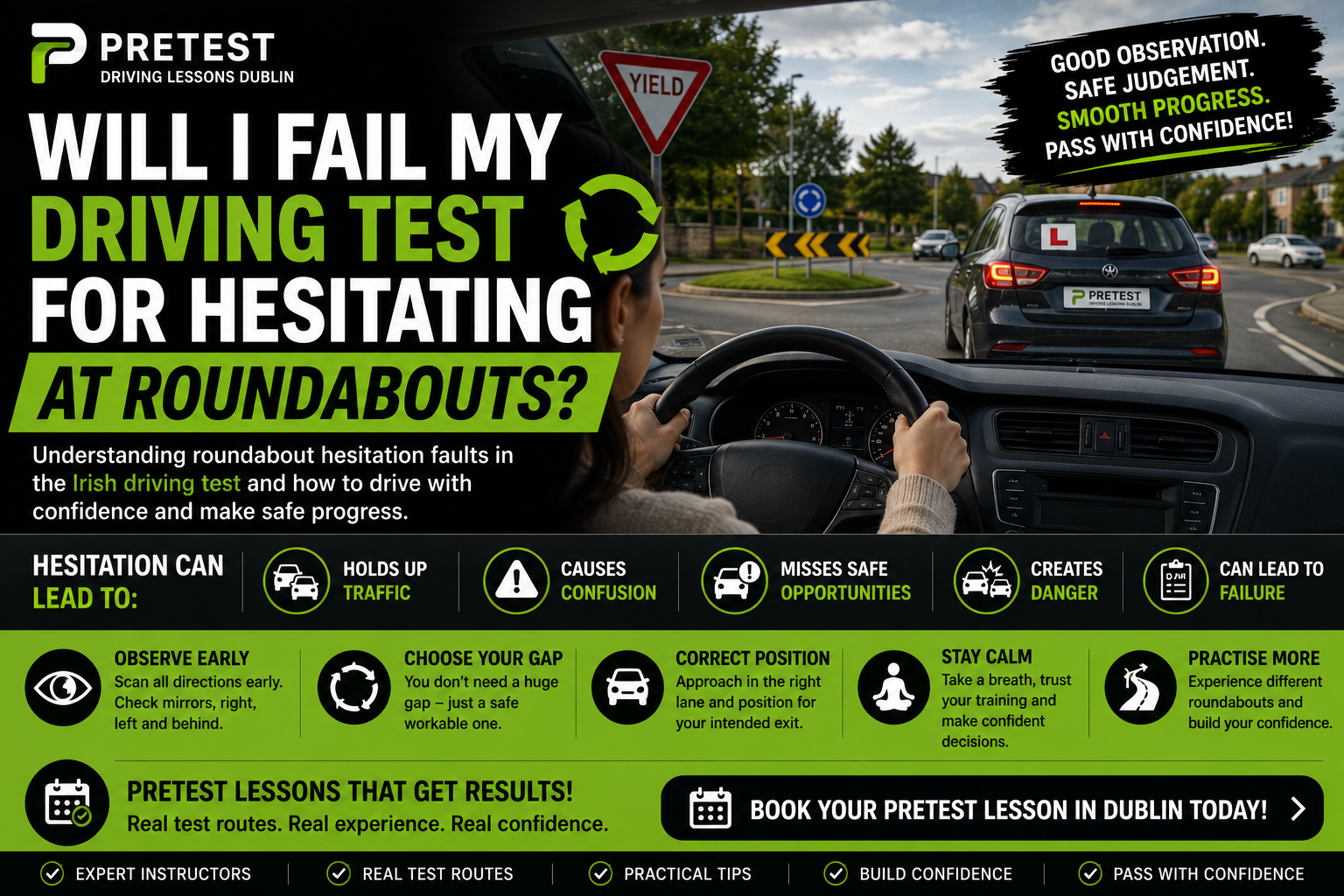
🔄 Will I Fail My Driving Test For Hesitating At Roundabouts?
Understanding Roundabout Hesitation Faults In The Irish Driving Test
Roundabouts are one of the BIGGEST pressure points during the Irish driving test.
Many learners:
⚠️ Wait too long
⚠️ Miss safe gaps
⚠️ Panic under pressure
⚠️ Stop unnecessarily
⚠️ Struggle with observation and timing
A small hesitation may NOT automatically fail the test…
But repeated hesitation at roundabouts can quickly become:
❌ Progress faults
❌ Observation faults
❌ Serious Grade 3 faults in dangerous situations
At Pretest Driving Lessons Dublin, we help learners improve:
✅ Roundabout confidence
✅ Gap judgement
✅ Observation routines
✅ Lane positioning
✅ Traffic awareness
🚗 Can You Fail For Hesitating At Roundabouts?
Yes — especially if hesitation becomes excessive.
Examiners understand:
- Learners may feel nervous
- Roundabouts are difficult
- Small delays are normal
However…
Repeated hesitation may suggest:
⚠️ Poor judgement
⚠️ Lack of confidence
⚠️ Poor progress
⚠️ Weak observation
The examiner wants to see:
Safe AND reasonable progress.
⚠️ When Roundabout Hesitation Becomes Serious
Hesitation may become serious if it:
⚠️ Blocks traffic
⚠️ Causes confusion
⚠️ Misses multiple safe opportunities
⚠️ Creates danger
⚠️ Forces risky reactions from other drivers
Example:
If several safe gaps appear and the learner refuses to move repeatedly, the examiner may view this as failure to make proper progress.
RSA marking guidelines strongly assess:
- Progress
- Observation
- Traffic management
- Decision making
🔄 Common Roundabout Mistakes Learners Make
👀 Looking Only Right
Very common issue.
Learners forget:
- Mirrors
- Lane position
- Exit planning
- Cyclists and pedestrians
⚡ Rushing Decisions
Some learners:
- Panic
- Pull out unsafely
- Misjudge speed
🐢 Waiting Too Long
Over-cautious learners often:
- Miss easy safe gaps
- Hold up traffic
- Build pressure behind them
🚗 Poor Lane Positioning
Wrong approach position increases hesitation massively.
❌ Why Learners Hesitate At Roundabouts
😰 Nervousness
Pressure affects judgement.
👀 Poor Observation
Late scanning creates panic decisions.
🧠 Overthinking
Many learners:
- Search for a “perfect gap”
- Instead of a safe realistic gap
🚦 Lack Of Practice
Confidence comes from repetition.
✅ What Examiners Actually Want To See
Examiners do NOT expect:
“Aggressive confident racing-driver behaviour.”
They want:
✅ Safe judgement
✅ Good observation
✅ Smooth progress
✅ Awareness
✅ Calm decision making
A learner who:
- Plans early
- Observes properly
- Takes safe opportunities
Usually performs very well.
🚘 How To Improve Roundabout Confidence
👀 Scan Earlier
Early observation reduces panic.
🔄 Practise Roundabout Routines
For example:
- Mirrors
- Position
- Speed
- Look
- Decide
- Go
Consistency builds confidence.
🚗 Learn Gap Judgement
You do NOT need:
“A giant empty roundabout.”
You need:
A SAFE workable gap.
🐢 Slow The Mind Down
Many hesitation faults happen because learners panic mentally before physically.
🔁 Practise Different Roundabouts
Especially:
✅ Mini roundabouts
✅ Multi-lane roundabouts
✅ Busy junctions
✅ Spiral roundabouts
🚦 Roundabout Situations That Cause Problems
🔄 Busy Multi-Lane Roundabouts
Huge pressure point.
🚘 Mini Roundabouts
Fast decision making required.
🚴 Cyclists On Roundabouts
Observation becomes critical.
🚗 Heavy Traffic Conditions
Learners often lose confidence quickly.
⭐ Final Thoughts
A small hesitation at a roundabout does NOT automatically fail the test.
The key is:
✅ Observation
✅ Safe progress
✅ Confidence
✅ Good judgement
✅ Calm reactions
Most learners improve roundabout performance VERY quickly once:
- Observation improves
- Confidence grows
- Gap judgement becomes clearer
NEED HELP GET IN TOUCH
🚘 Nervous About Roundabouts?
Our pretest driving lessons focus heavily on:
✅ Roundabout confidence
✅ Observation routines
✅ Lane discipline
✅ Gap judgement
✅ Real test routes
✅ Common fail areas
👉 Book A Pretest Driving Lesson In Dublin Today
FAQ SECTION
❓Can hesitation at roundabouts fail the driving test?
Yes. Repeated hesitation affecting progress or safety may result in failure.
❓Do examiners expect learners to take small gaps?
No. Examiners want safe judgement, not risky decisions.
❓Why do learners struggle at roundabouts?
Usually because of nerves, poor observation, weak gap judgement, or lack of practice.
❓How can I improve roundabout confidence?
Practise observation routines, improve lane positioning, and build experience gradually.
USEFUL TOPICS
- Roundabout Observation Faults
- Will I Fail Driving Test For Hesitation Ireland
- Observation Faults Driving Test Ireland
- Driving Test Progress Faults Explained
- Driving Too Slow Driving Test Ireland
- Yield Right Of Way Faults Ireland
- Traffic Light Anticipation Driving Test Ireland
- Failed Driving Test Again Ireland
- How Many Grade 2 Faults Is A Fail Ireland
- Driving Test Recovery Lesson Dublin