Yield Right of Way Faults in the Irish Driving Test
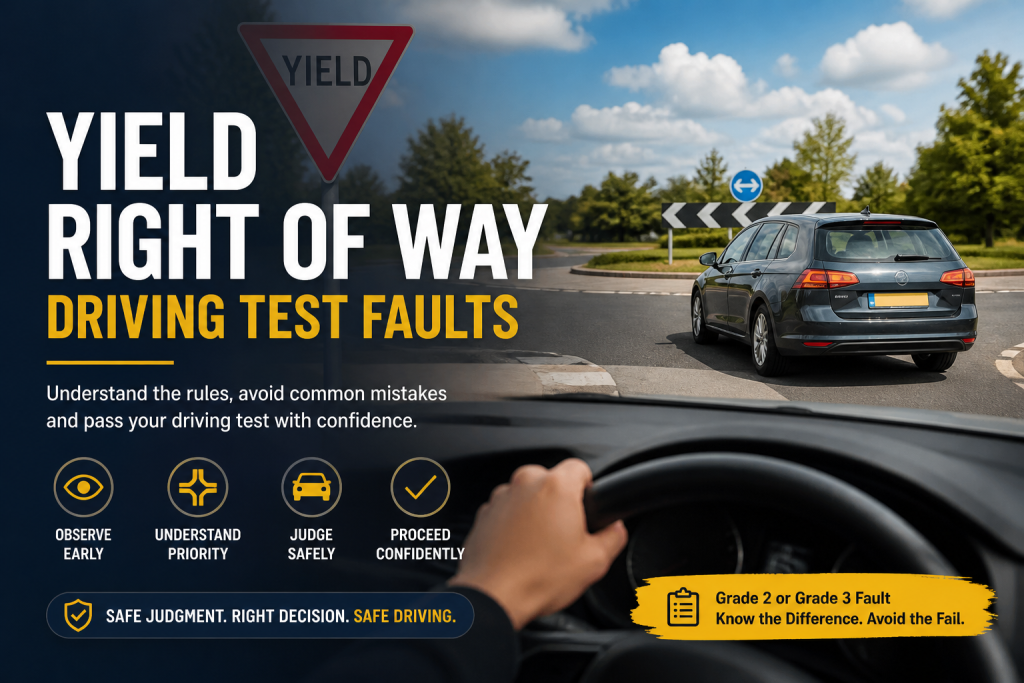
Failing to yield right of way correctly is one of the most common reasons learner drivers fail the Irish driving test. At busy junctions, roundabouts, crossroads, and traffic-calmed areas, examiners are watching closely to see if you can judge traffic safely and confidently.
Many learners either:
- Pull out when it is unsafe
- Hesitate too long and block traffic
- Misjudge approaching vehicles
- Stop unnecessarily
- Or force another driver to react
These mistakes can quickly result in a Grade 2 or even a Grade 3 fault.
According to RSA driving test marking guidelines, failing to yield right of way causing inconvenience is marked as a Grade 2 fault, while causing danger is marked as a Grade 3 fault (automatic fail).
What Does “Yield Right of Way” Mean?
Yielding right of way means:
- Allowing traffic with priority to continue safely
- Not forcing other road users to brake, slow, stop, or change direction
- Making safe decisions at junctions and roundabouts
- Understanding who has priority in different traffic situations
This is assessed constantly during the driving test.
Common Places Learners Get Yield Faults
Roundabouts
Roundabouts are one of the biggest problem areas in the driving test.
Common mistakes include:
- Pulling out in front of traffic approaching from the right
- Hesitating excessively when safe gaps exist
- Entering too quickly
- Incorrect lane positioning affecting other vehicles
- Failing to anticipate fast-moving traffic
Traffic already on the roundabout normally has priority. Pulling out incorrectly can instantly become a Grade 3 fault.
T-Junctions & Crossroads
Many learners fail to:
- Judge the speed of approaching traffic
- Complete proper observations
- Move forward enough for visibility
- Commit confidently when a safe gap appears
A common issue is creeping too slowly into traffic and causing hesitation or obstruction.
Turning Right Across Traffic
This happens frequently during the test.
Typical faults include:
- Not waiting for a safe gap
- Misjudging oncoming vehicles
- Turning too slowly
- Blocking traffic behind
- Cutting across another driver’s path
The examiner wants to see:
✔ Good observation
✔ Correct road position
✔ Early planning
✔ Confident decision-making
Emerging from Minor Roads
Learners often:
- Stop too far back
- Fail to edge forward safely
- Rush out without proper observation
- Depend only on mirrors instead of direct observation
Poor visibility is not an excuse for poor judgment. Examiners expect learners to use controlled “peep and creep” techniques safely.
RSA Marking Guidelines Explained
The RSA marking system separates faults into different grades.
Grade 2 Yield Fault
A Grade 2 fault usually means:
- Another road user was inconvenienced
- You hesitated unnecessarily
- You misjudged a situation slightly
- Safety was not seriously compromised
Examples:
- A driver slightly slows because you moved out late
- Hesitating too long at a safe gap
- Delayed progress at a junction
Grade 3 Yield Fault (Automatic Fail)
A Grade 3 fault occurs when:
- Safety is compromised
- Another driver must brake sharply
- A vehicle changes direction because of you
- You force traffic to react suddenly
- You create danger at a junction or roundabout
The RSA guidelines state that failing to yield right of way causing danger is a Grade 3 fault.
Why Learners Struggle With Right of Way
Most problems come from:
Poor Observation
Learners often look but fail to properly assess:
- Speed
- Distance
- Traffic flow
- Hidden hazards
Observation is not just turning your head — it is understanding what is happening.
Fear & Hesitation
Some learners become overly cautious during the test.
Ironically, waiting too long can also cause faults for:
- Progress
- Hesitation
- Yield right of way
Safe driving requires confidence as well as caution.
Rushing Decisions
Other learners panic and “go for gaps” that are too small.
This usually happens when:
- Traffic builds behind them
- They feel under pressure
- They fear holding people up
Examiners prefer a slightly cautious driver over a dangerous one.
Top Tips to Avoid Yield Right of Way Faults
1. Scan Early
Do not wait until the last second.
Start reading the junction or roundabout early:
- Traffic speed
- Road position
- Indicators
- Pedestrians
- Cyclists
2. Understand Priority
Know who has right of way before arriving.
This reduces panic and hesitation.
3. Keep the Car Moving Slowly
At junctions with poor visibility:
- Edge forward slowly
- Keep observations active
- Avoid stopping too early
This improves visibility and confidence.
4. Do Not Rush Because of Traffic Behind
The examiner cares about safety — not impatient drivers behind you.
Take safe gaps only.
5. Practice Real Test Routes
Many yield faults happen at:
- Busy roundabouts
- Hidden junctions
- Fast-moving crossroads
- Multi-lane traffic systems
Practising local driving test routes helps learners recognise these pressure points before the test.
Signs You May Be Picking Up Yield Faults
You may be struggling with right of way if you:
- Frequently get beeped at
- Miss safe gaps repeatedly
- Rush out at roundabouts
- Brake suddenly at junctions
- Feel panicked in heavy traffic
- Cause other drivers to react to you
These are warning signs that your timing and judgment need work before the test.
How We Help Learners Fix Yield Faults
At Pretest Driving Lessons Dublin, we focus heavily on:
✔ Roundabout judgment
✔ Gap selection
✔ Hazard anticipation
✔ Confidence building
✔ Correct observations
✔ Real driving test routes
✔ Traffic flow awareness
Many learners fail not because they cannot drive — but because they panic under pressure at busy junctions.
With structured practice and calm coaching, these faults can usually be corrected quickly.
Related Driving Test Fault Guides
- Observation Faults Driving Test Ireland
- Roundabout Faults Driving Test
- Hesitation Faults Driving Test Ireland
- Progress Faults Driving Test
- Grade 2 vs Grade 3 Faults Explained
- Common Reasons Learners Fail the Driving Test
Final Thoughts
Yield right of way faults are heavily linked to:
- Observation
- Confidence
- Planning
- Hazard awareness
- Decision-making
The key is learning to balance safe judgment with steady progress.
A learner who hesitates too much can fail.
A learner who rushes can fail even faster.
The goal is calm, controlled, confident decision-making every time you approach a junction or roundabout.
Sources & RSA Marking References
RSA driving test marking guidelines and Irish driving instructor analysis were referenced for this article.