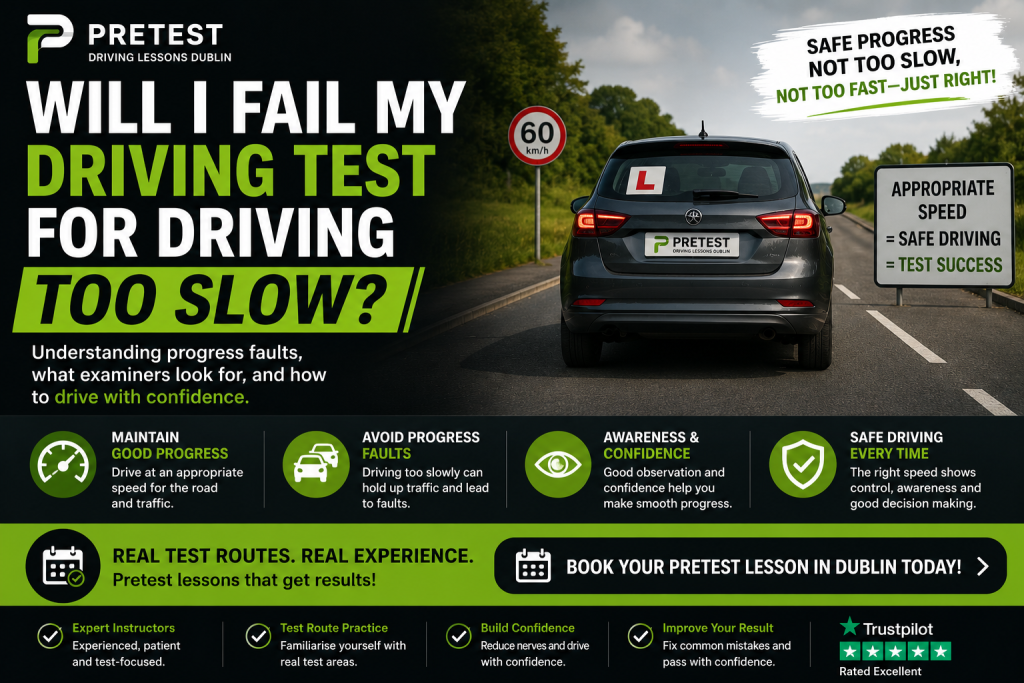
🐢 Will I Fail My Driving Test For Driving Too Slow?
Understanding Progress Faults In The Irish Driving Test
Many learner drivers think:
“Driving slower must be safer.”
But during the Irish driving test, driving too slowly can actually become:
⚠️ A progress fault
⚠️ A hesitation issue
⚠️ Or even a serious fault if traffic is affected
Examiners want to see:
✅ Safe driving
✅ Proper progress
✅ Confidence
✅ Awareness of road conditions
At Pretest Driving Lessons Dublin, we help learners understand:
- Appropriate speed
- Road positioning
- Traffic flow
- Progress faults
- Confidence behind the wheel
🚗 Can You Fail For Driving Too Slow?
Yes — in some situations.
A learner who consistently drives:
- Well below the speed limit
- Hesitates unnecessarily
- Holds up traffic
- Appears nervous or uncertain
May receive:
❌ Grade 2 progress faults
❌ Multiple progress marks
❌ Or a Grade 3 fault if serious disruption occurs
The key issue is:
Making safe, reasonable progress.
⚠️ What Examiners Actually Look For
Examiners do NOT expect learners to:
- Speed
- Rush
- Drive aggressively
But they DO expect:
✅ Appropriate speed
✅ Awareness of road conditions
✅ Confidence
✅ Smooth progress
✅
missing some sections
🛣️ Common Situations Where Learners Drive Too Slowly
🚦 Open Main Roads
Some learners stay:
- 10–20 km/h under the limit
- Even when conditions are safe
This can quickly affect:
- Progress marks
- Traffic flow
- Examiner confidence
🔄 Roundabouts
Nervous learners often:
- Approach far too slowly
- Hesitate excessively
- Miss safe opportunities
This can create both:
⚠️ Hesitation faults
⚠️ Progress faults
🚘 Dual Carriageways
A very common issue.
Learners sometimes:
- Avoid building speed
- Stay nervous joining faster traffic
- Struggle with confidence
Examiners need to see:
✅ Safe merging
✅ Reasonable acceleration
✅ Good awareness
🚗 Straight Clear Roads
Driving too slowly on clear roads may suggest:
- Nervousness
- Poor confidence
- Lack of road awareness
❌ Why Driving Too Slowly Can Be Dangerous
Many learners think:
“Slow equals safe.”
But overly slow driving can actually:
⚠️ Frustrate other drivers
⚠️ Disrupt traffic flow
⚠️ Cause risky overtakes
⚠️ Create confusion
⚠️ Show lack of confidence
Safe driving means:
Matching speed to road and traffic conditions.
📋 What Is A Progress Fault?
A progress fault happens when the learner:
- Fails to maintain reasonable progress
- Delays traffic unnecessarily
- Hesitates repeatedly
- Shows lack of confidence
RSA driving test marking guidelines place importance on maintaining safe and appropriate progress throughout the test.
🚦 When Slow Driving Becomes A Serious Fault
Driving too slowly may become serious if it:
⚠️ Creates danger
⚠️ Causes major traffic disruption
⚠️ Forces risky overtakes
⚠️ Continues repeatedly throughout the test
⚠️ Shows inability to cope with traffic conditions
Example:
Driving at 40 km/h on a safe 60 km/h road for long periods without reason may attract serious attention from the examiner.
✅ How To Improve Driving Progress Before Your Test
👀 Improve Observation
Better observation improves confidence.
Learners who scan early:
✅ Make smoother decisions
✅ Maintain better speed
✅ Hesitate less
🧠 Stop Overthinking
Many slow-driving faults happen because learners:
- Fear making mistakes
- Become too cautious
- Panic under pressure
Calm confidence usually produces better progress.
🚗 Learn Road Speeds Properly
Understanding:
- Road type
- Traffic conditions
- Appropriate speed
Makes driving feel much easier.
🔁 Practise Real Test Routes
Confidence improves massively when learners:
✅ Know local roads
✅ Understand roundabouts
✅ Practise busier areas
✅ Experience realistic test conditions
🚘 Signs You May Be Driving Too Slowly
⚠️ Traffic Building Behind You
A major warning sign.
⚠️ Missing Safe Gaps
Especially at roundabouts and junctions.
⚠️ Constant Braking
Nervous learners often overuse brakes unnecessarily.
⚠️ Feeling Rushed By Other Drivers
Usually linked to confidence and planning issues.
⭐ Final Thoughts
Driving too slowly does NOT automatically fail the driving test.
But:
❌ Repeated poor progress
❌ Excessive hesitation
❌ Holding up traffic unnecessarily
Can seriously affect your result.
The goal is:
✅ Safe
✅ Smooth
✅ Confident progress
With proper practice, most learners improve progress faults very quickly.
🚘 Need Help Improving Confidence & Progress?
Our pretest driving lessons focus heavily on:
✅ Progress faults
✅ Roundabouts
✅ Observation
✅ Confidence building
✅ Traffic flow
✅ Real test routes
👉 Book A Pretest Driving Lesson In Dublin Today
FAQ SECTION
❓Can you fail your driving test for driving too slowly?
Yes. Repeated slow driving that affects progress or traffic flow may lead to failure.
❓What is considered too slow during the Irish driving test?
Driving significantly below the speed limit without good reason may attract progress faults.
❓Do examiners expect learners to drive at the speed limit?
Not always exactly at the limit, but learners should make safe and reasonable progress where conditions allow.
❓Why do learners drive too slowly during tests?
Usually because of nerves, overthinking, hesitation, or lack of confidence.
🚘 Other test topics
Yield Right Of Way Faults Ireland
Will I Fail Driving Test For Hesitation Ireland
Observation Faults Driving Test Ireland
Roundabout Observation Faults
Driving Test Progress Faults Explained
Traffic Light Anticipation Driving Test Ireland
Failed Driving Test Again Ireland
How Many Grade 2 Faults Is A Fail Ireland
Last Minute Driving Test Tips Ireland
Driving Test Recovery Lesson Dublin