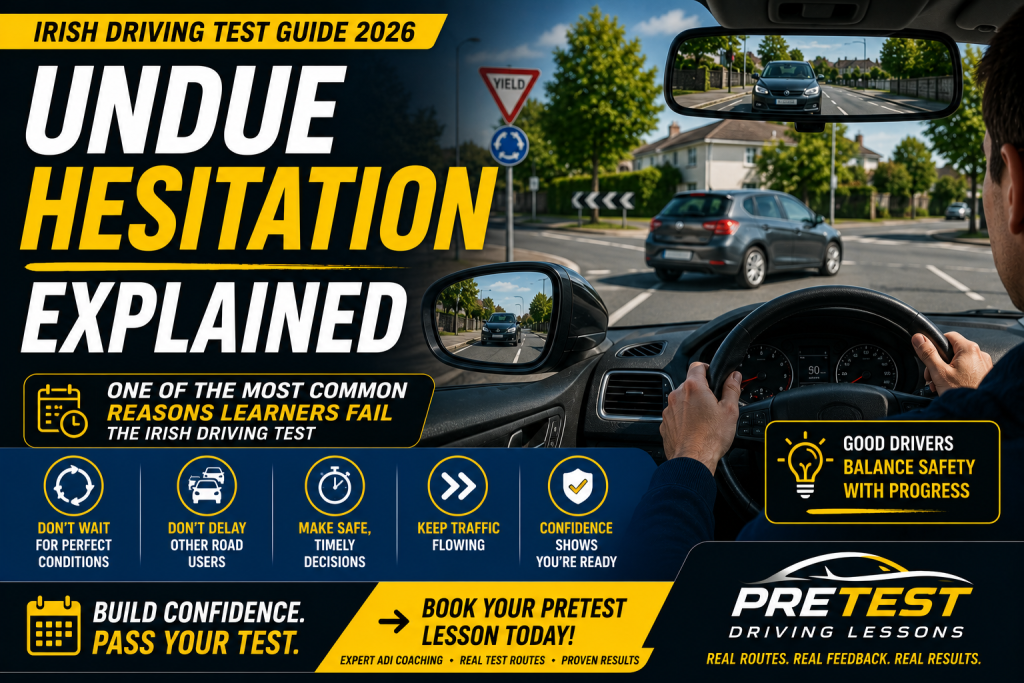
🚗 Undue Hesitation Explained: One Of The Most Common Reasons Learners Fail The Irish Driving Test
Many learners believe it’s better to wait “just a little longer” before pulling out, entering a roundabout, or turning at a junction.
While caution is important, waiting when it’s clearly safe to proceed can actually lose you marks.
This is called undue hesitation, and it’s one of the most common reasons otherwise capable learners fail their Irish driving test.
The examiner wants to see that you can make safe, timely decisions—not rushed decisions, but not unnecessarily delayed ones either.
What Is Undue Hesitation?
Undue hesitation happens when a learner:
- Waits for an unnecessary gap in traffic.
- Misses several safe opportunities to move.
- Delays other road users without good reason.
- Shows a lack of confidence despite conditions being safe.
It’s different from being cautious.
Good drivers balance safety with progress.
Common Situations Where Learners Hesitate
🔄 Roundabouts
Waiting for the roundabout to become completely empty.
In reality, you only need a safe gap.
↩ Right Turns
Learners often wait through several opportunities before turning.
If you’ve judged the gap correctly, move confidently.
🚦 Traffic Lights
The light turns green…
The traffic ahead moves…
But the learner pauses for several seconds before setting off.
Repeated delays can affect your progress.
🚗 Moving Off From The Kerb
After completing observations, some learners still wait even though the road is clear.
🚧 Junctions
Missing multiple safe opportunities because you’re hoping for an even bigger gap.
Why Is Undue Hesitation A Problem?
Other drivers expect traffic to flow normally.
If you repeatedly fail to move when it’s safe:
🚗 Traffic builds behind you.
🚴 Cyclists may attempt to pass.
🚙 Other drivers become unpredictable.
⚠️ New hazards can develop.
Sometimes waiting actually creates more risk than moving.
How Examiners Assess Hesitation
The examiner considers:
- Was it safe to proceed?
- Did the learner have enough time?
- Did they unnecessarily delay traffic?
- Did hesitation happen repeatedly?
One cautious pause won’t usually fail you.
A pattern of unnecessary hesitation can.
The Difference Between Safe Caution And Undue Hesitation
✅ Safe Caution
- Limited visibility.
- Fast-approaching traffic.
- Pedestrians stepping onto the road.
- Cyclists creating uncertainty.
- You’re genuinely waiting for a safe gap.
❌ Undue Hesitation
- Road is clear.
- Safe gap available.
- Other drivers expect you to move.
- You continue waiting because you’re unsure.
Five Ways To Reduce Hesitation
👀 Look Further Ahead
Early observation gives you more time to judge traffic.
🧠 Decide Before You Reach The Junction
Don’t leave every decision until the last second.
🚗 Trust Your Gap Judgement
If you’ve practised with an instructor, use that training.
🚦 Commit Once It’s Safe
After deciding, move positively.
Half-decisions often create bigger problems.
😊 Stay Calm
Nerves often cause hesitation.
Focus on what you can see—not on “what if” scenarios.
Frequently Asked Questions
Can undue hesitation fail the driving test?
Yes. If it repeatedly delays traffic or shows poor progress, it can contribute to a failed test.
Is it better to wait longer?
Only if waiting genuinely makes the situation safer.
Waiting for perfect conditions is rarely necessary.
Does hesitation happen at roundabouts?
Yes. Roundabouts are one of the most common places where learners lose marks for hesitation.
Can I lose marks for taking too long at junctions?
Yes, if several safe opportunities are missed without a valid reason.
Is caution a good thing?
Absolutely.
The goal is appropriate caution, not unnecessary delay.
Related Guides
➡️ Driving Too Slowly During The Irish Driving Test
➡️ Observation Faults Explained
➡️ How To Judge Safe Gaps In Traffic
➡️ Roundabouts Explained
➡️ Common Reasons Learners Fail The Irish Driving Test
🚗 Learn To Make Safe, Confident Decisions
Undue hesitation isn’t about being too careful—it’s about missing opportunities that are clearly safe.
At Pretest Driving Lessons, we’ll help you judge gaps confidently, improve your decision-making at roundabouts and junctions, and practise on real Tallaght driving test routes where learners commonly lose marks for hesitation. You’ll learn how to move positively without taking unnecessary risks.
✅ Ready to replace hesitation with confidence?
Book your pretest driving lesson today and discover how to make safe, timely decisions that keep traffic flowing, demonstrate confidence to the examiner, and give you the best possible chance of passing your Irish driving test first time. With personalised coaching, realistic test-route practice, and honest feedback, you’ll leave knowing exactly what to improve before test day.