Many learner drivers believe that driving slowly is the safest option during their driving test.
Unfortunately, that’s not always true.
While the examiner never expects you to speed, they do expect you to make safe, confident progress whenever road and traffic conditions allow.
Driving well below the appropriate speed can frustrate other road users, create unnecessary hazards, and lead to faults on your driving test.
The key is to drive at a speed that is safe, legal and appropriate for the conditions—not simply as slowly as possible.
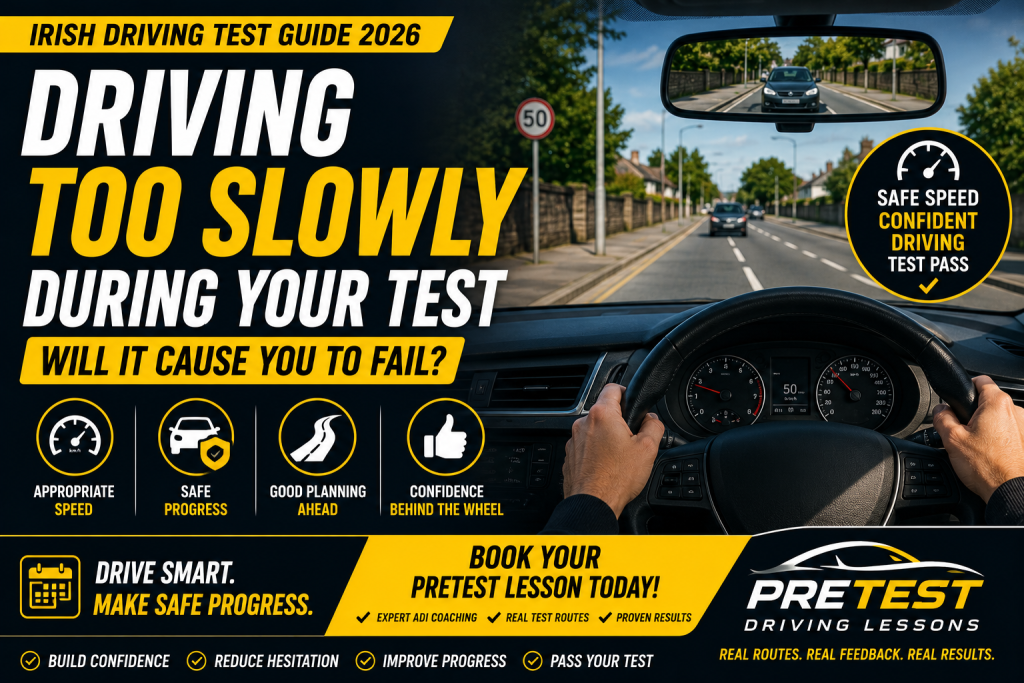
Can Driving Too Slowly Cause You To Fail?
Yes.
If your slow speed repeatedly affects traffic or shows a lack of confidence, it can contribute to a failed driving test.
The examiner wants to see that you can:
✅ Read the road ahead
✅ Judge speed correctly
✅ Keep up with normal traffic flow
✅ Drive confidently without causing delays
Driving safely does not mean driving timidly.
What Is “Making Progress”?
Progress means:
- Driving close to the appropriate speed limit when conditions allow.
- Accelerating smoothly after junctions.
- Moving away promptly when it is safe.
- Avoiding unnecessary hesitation.
- Keeping traffic flowing naturally behind you.
Good progress shows confidence, planning and awareness.
Common Speed Mistakes Learners Make
🚗 Driving 20 km/h Below The Limit On Clear Roads
If the road is clear and conditions are good, driving well below the limit can become a fault.
🚦 Slow To Accelerate
Many learners leave junctions and roundabouts too slowly.
This often causes traffic to bunch up behind them.
🚧 Hesitating After Every Hazard
Once a hazard has passed, build your speed again when it is safe.
Don’t continue driving slowly because of something that happened several hundred metres ago.
🛣️ Not Matching Traffic Flow
Within the speed limit, you should aim to move naturally with the surrounding traffic.
When Driving Slowly Is The Correct Decision
The examiner expects you to reduce speed when:
🚸 Approaching schools
🚶 Pedestrians are nearby
🚲 Cyclists reduce available space
🌧️ Heavy rain affects visibility
🌫️ Fog limits your view
🚗 Parked cars restrict the road
⚠️ Sharp bends reduce vision
Safe driving always comes before maintaining speed.
How Examiners Assess Progress
The examiner isn’t looking at your speedometer every few seconds.
Instead, they assess whether your speed is appropriate for:
- The speed limit
- Traffic conditions
- Road layout
- Weather
- Visibility
- Hazards ahead
A confident learner adjusts speed smoothly rather than driving at one fixed pace.
Five Tips To Improve Your Progress
👀 Look Further Ahead
Early planning allows smoother speed adjustments.
🚦 Accelerate Positively
Once it’s safe, build speed confidently.
🚗 Trust Your Training
Many learners are capable of driving faster but become overly cautious because they’re afraid of making mistakes.
🛣️ Read The Road
A clear road allows steady progress.
A busy road requires flexibility.
🧠 Think “Appropriate”, Not “Slow”
Ask yourself:
“Am I driving at the right speed for these conditions?”
That’s exactly what the examiner is assessing.
Frequently Asked Questions
Can I fail for driving too slowly?
Yes. If it repeatedly affects other road users or shows poor progress, it can contribute to a failed test.
Is it better to drive under the speed limit?
Only when road conditions require it.
On a clear road, driving significantly below the limit without good reason may result in faults.
Does the examiner expect me to reach the speed limit?
Not always.
They expect you to drive at a speed that is safe and appropriate for the conditions.
Will speeding slightly help me pass?
No.
Exceeding the speed limit is never acceptable.
The goal is appropriate progress, not maximum speed.
Is hesitation linked to driving too slowly?
Often, yes.
Unnecessary hesitation and poor progress are closely connected and can both affect your result.
Related Guides
➡️ Observation Faults Explained
➡️ Moving Off Safely
➡️ How To Handle Roundabouts During Your Driving Test
➡️ Common Reasons Learners Fail The Irish Driving Test
🚗 Drive With Confidence—Not Caution Alone
One of the biggest differences between learners who pass and those who fail is confidence in making safe progress.
At Pretest Driving Lessons, you’ll practise on real Tallaght driving test routes where learners often lose marks for poor progress, hesitation and inappropriate speed. We’ll help you judge the correct speed for every situation, build confidence in traffic, and develop the decision-making skills examiners want to see.
✅ Ready to drive like a confident, test-ready learner?
Book your pretest driving lesson today and learn how to make safe, steady progress that keeps traffic flowing, impresses the examiner, and gives you the best chance of passing your Irish driving test first time. You’ll receive personalised coaching, honest feedback, and practical techniques you can use on your very next drive.
Get in touch today by contacting us on 0857335950 and join these success stories