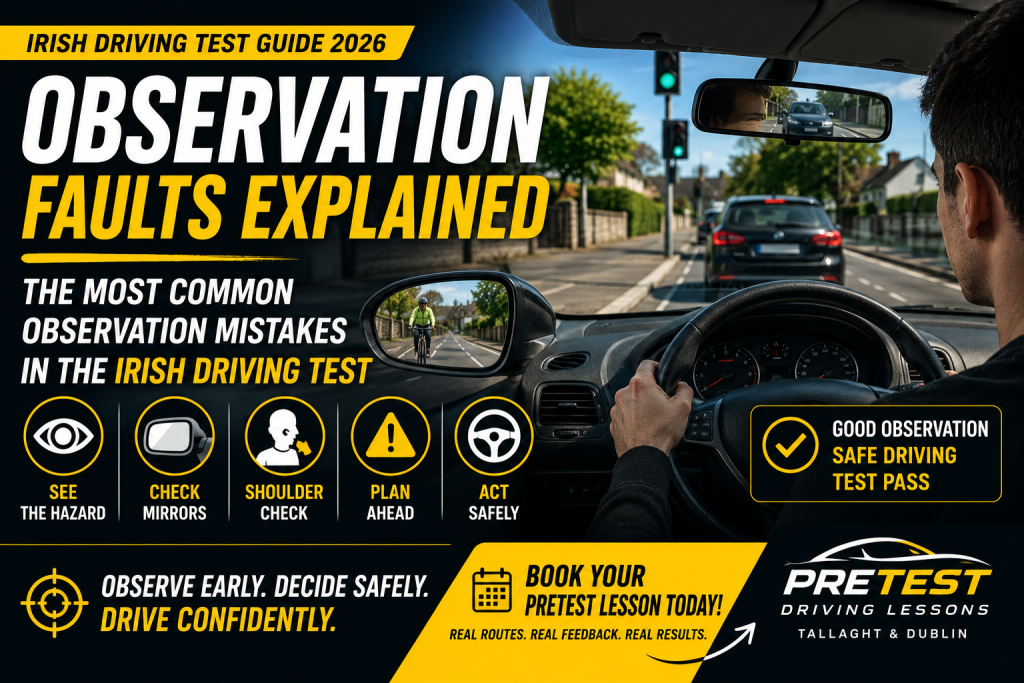
If you ask experienced driving instructors why learners fail their Irish driving test, one answer comes up again and again:
Poor observation.
Many learners can control the car well, know the rules of the road and complete manoeuvres confidently—but still lose marks because they don’t observe properly.
The good news is that observation is one of the easiest skills to improve once you know what the examiner is looking for.
What Does “Observation” Actually Mean?
Observation isn’t simply looking around.
It means gathering information before, during and after every decision you make.
The examiner wants to see that you are constantly aware of:
🚗 Other vehicles
🚴 Cyclists
🚶 Pedestrians
🛵 Motorcyclists
🚦 Traffic lights
🚧 Road signs
⚠️ Hazards developing ahead
Good observation allows you to plan early and drive smoothly rather than reacting at the last second.
The Most Common Observation Faults
🚗 1. Moving Off Without A Blind Spot Check
One of the most common faults.
Before moving away from the kerb you should:
🪞 Interior mirror
🪞 Right mirror
➡️ Signal (if required)
👀 Blind spot
🚗 Move away
Skipping the shoulder check can easily lead to faults.
🔄 2. Poor Observation At Junctions
Learners often:
❌ Stop
❌ Look once
❌ Drive out
Instead, observation should continue until you’re actually joining the new road.
Traffic conditions change every second.
🔄 3. Looking But Not Seeing
Some learners turn their head without actually assessing what’s happening.
The examiner isn’t marking head movement.
They’re marking whether you’ve gathered useful information.
🚦 4. Focusing Too Close To The Car
New drivers often stare just a few metres ahead.
Good drivers scan well down the road.
Looking further ahead gives you more time to react.
🚴 5. Missing Vulnerable Road Users
Cyclists.
Motorcyclists.
Pedestrians.
Children.
E-scooters.
These road users are often involved in observation faults because learners become too focused on vehicles.
🔁 6. Forgetting Mirror Checks
Mirrors should become automatic.
The examiner expects regular mirror checks:
✔ Before slowing
✔ Before speeding up
✔ Before changing direction
✔ Before signalling
✔ Before changing lanes
⚠️ 7. Late Observation
Looking too late can be almost as dangerous as not looking at all.
Observation should happen early enough for you to make safe decisions without harsh braking or sudden steering.
How Examiners Assess Observation
The examiner isn’t counting how many times you look in your mirrors.
Instead, they’re asking:
✅ Did the learner notice the hazard?
✅ Did they react early?
✅ Was the observation appropriate for the situation?
Driving should look calm, planned and safe—not rushed or robotic.
A Simple Observation Routine
Whenever you’re about to change speed or direction, remember:
🪞 Mirrors
➡️ Signal (if needed)
👀 Observe all around
🚗 Act smoothly
This routine quickly becomes second nature with practice.
Five Ways To Improve Your Observation
👀 Look Further Ahead
Aim to scan well beyond the car in front.
🪞 Make Mirror Checks A Habit
Don’t wait until the examiner reminds you.
🚲 Expect Cyclists Everywhere
Especially in urban areas and near junctions.
👤 Make Shoulder Checks Obvious
Natural—but visible.
🧠 Keep Planning
Ask yourself continuously:
“What could happen next?”
Planning ahead dramatically reduces observation faults.
Frequently Asked Questions
Are observation faults common?
Yes. They are among the most common reasons learners receive faults during the Irish driving test.
Can poor observation fail the driving test?
Yes. If poor observation creates danger or repeatedly shows a lack of awareness, it can lead to failure.
Does checking mirrors too much lose marks?
No—but exaggerated or unnecessary checks can distract you from what’s happening ahead.
Do examiners watch your eyes?
No.
They look for clear, natural head movements and, more importantly, safe driving decisions based on good observation.
Is observation tested throughout the driving test?
Yes.
From the moment you move off until the test finishes.
Related Guides
➡️ How To Perform A Proper Blind Spot Check
➡️ Will I Fail My Driving Test For Not Checking Blind Spots?
➡️ Do I Need To Check My Blind Spot Every Time?
➡️ Moving Off Safely During The Irish Driving Test
🚗 Turn Observation Into Your Biggest Strength
Observation isn’t about memorising a routine—it’s about developing safe driving habits that become automatic.
At Pretest Driving Lessons, we’ll coach you through real Tallaght driving test routes, showing you exactly where learners lose marks for observation and how to avoid those mistakes. You’ll receive practical feedback, personalised coaching, and proven techniques used by successful learners every week.
✅ Ready to drive with confidence?
Book your pretest driving lesson today and learn exactly what Irish driving examiners want to see. We’ll help you build natural observation habits, eliminate costly mistakes, and give yourself the best possible chance of passing your driving test first time.