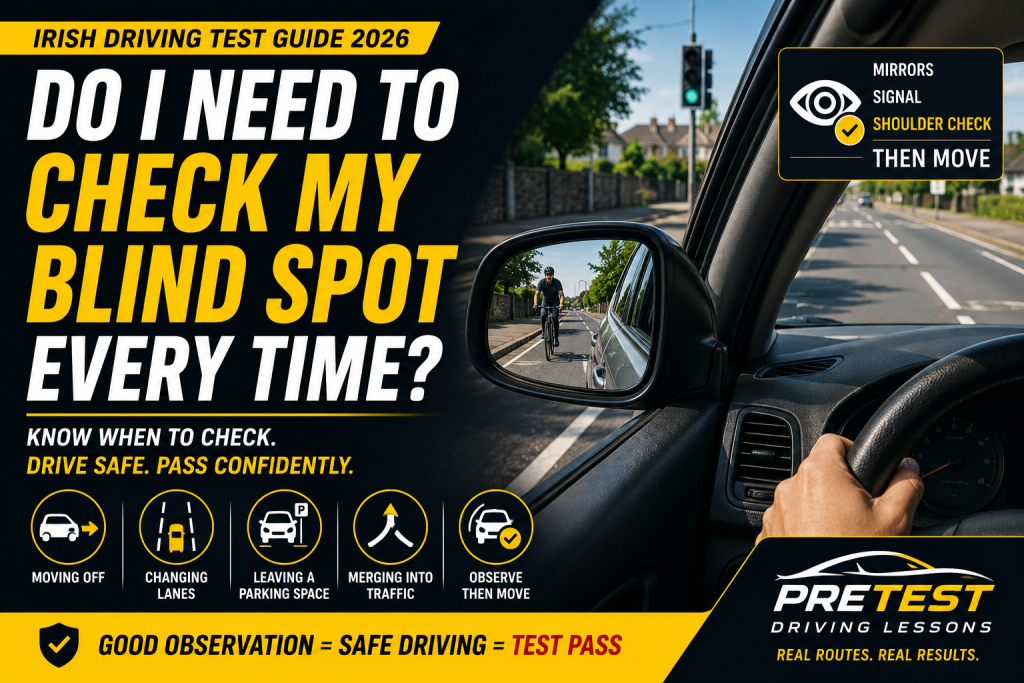
🚗 Do I Need To Check My Blind Spot Every Time?
One of the biggest myths among learner drivers is:
“I should check my blind spot every few seconds.”
That’s not what the RSA expects.
Blind spot checks are not something you do constantly.
Instead, you perform them before your vehicle moves into a space your mirrors cannot fully see.
Knowing when to check—and when you don’t need to—makes your driving smoother and more natural.
✅ When You SHOULD Check Your Blind Spot
A shoulder check is normally expected before:
🚗 Moving away from the kerb
🚗 Pulling away after stopping
🚗 Leaving a parking space
🚗 Changing lanes
🚗 Merging into traffic
🚗 Overtaking parked vehicles where appropriate
🚗 Rejoining traffic
Each of these manoeuvres involves moving into an area your mirrors cannot fully cover.
❌ When You DON’T Normally Need One
You don’t need a blind spot check every time you:
✔ Drive straight ahead
✔ Follow a bend in the road
✔ Stop at traffic lights
✔ Approach a junction
✔ Drive through a roundabout lane without changing lanes
✔ Continue in the same lane
Your mirrors and forward observation are usually enough in these situations.
👀 Why Mirrors Aren’t Enough
Your mirrors leave small areas hidden.
These hidden areas can contain:
🚴 Cyclists
🛵 Motorcyclists
🛴 E-scooters
🚶 Pedestrians
Another vehicle sitting just beside you.
That’s why the examiner expects a quick shoulder check whenever you’re moving sideways into another road user’s path.
❌ Mistake 1 – Checking Too Often
Some learners perform shoulder checks every few seconds.
This isn’t safer.
It can actually reduce the amount of time you’re looking ahead.
The examiner wants appropriate observation, not constant head movements.
❌ Mistake 2 – Never Checking
Others rely only on mirrors.
This is equally risky because mirrors cannot eliminate blind spots.
❌ Mistake 3 – Checking Too Early
A shoulder check done five or six seconds before moving is almost useless.
Traffic conditions can change quickly.
The check should happen immediately before you move.
The Simple Rule To Remember
Ask yourself one question:
“Am I about to move into a space I cannot fully see in my mirrors?”
If the answer is yes, perform a blind spot check.
If the answer is no, your normal observation routine is usually enough.
This simple question helps learners avoid both under-checking and over-checking.
Test Day Example
Imagine you’re parked at the kerb.
Your routine should be:
🪞 Interior mirror
🪞 Right mirror
➡️ Signal (if needed)
👀 Blind spot
🚗 Move away
Not:
Mirror…
Wait…
Mirror…
Drive…
Blind spot halfway through moving.
The blind spot check must come immediately before the vehicle begins to move.
Frequently Asked Questions
Do I need a blind spot check before every turn?
No. Only when your movement could place you into the path of another road user.
Do I need one before changing lanes?
Yes. This is one of the most important times to perform a shoulder check.
Do I need one at roundabouts?
Usually only if you’re changing lanes or moving into another lane.
Will checking too often lose marks?
Not usually, but excessive head movement can make your driving appear uncertain or reduce your forward observation.
Does the examiner need to see my head move?
Yes. Make the movement natural but clear enough that the examiner can see you’ve checked.
Related Guides
➡️ How To Perform A Proper Blind Spot Check
➡️ Will I Fail My Driving Test For Not Checking Blind Spots?
➡️ Moving Off Safely During The Irish Driving Test
➡️ Observation Faults Explained
➡️ How Examiners Assess Observation During Your Driving Test
🚗 Build Better Observation Habits Before Your Test
Blind spot checks shouldn’t feel forced—they should become part of your natural driving routine.
At Pretest Driving Lessons, we’ll show you exactly when shoulder checks are required on real Tallaght test routes, helping you develop safe habits that impress the examiner and keep you safe long after you’ve passed.
Book your pretest lesson today and drive with confidence on test day.