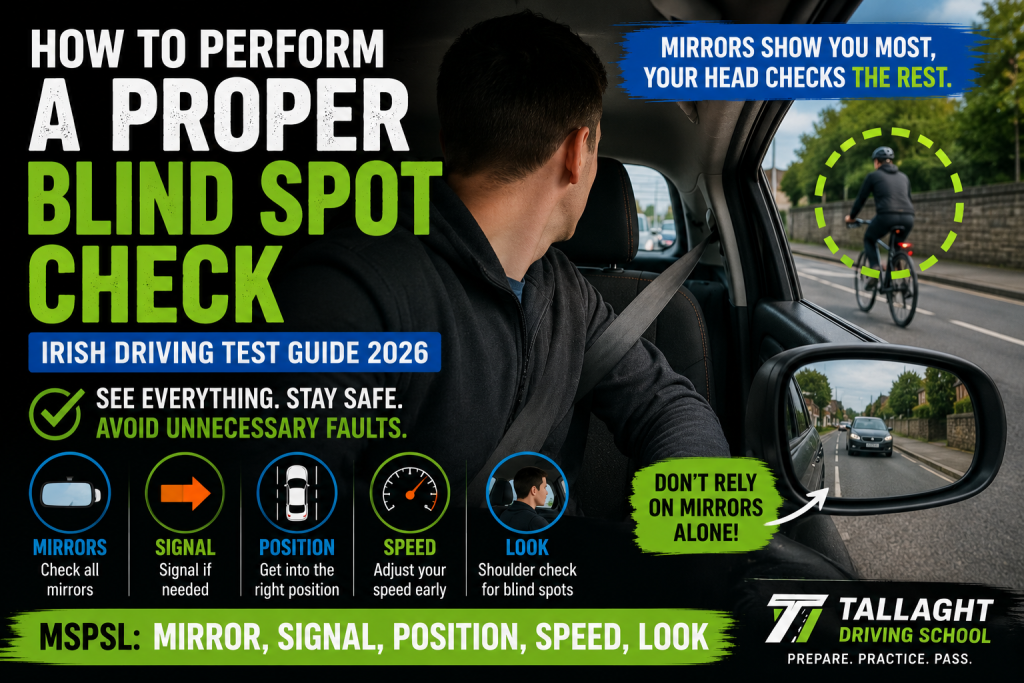
One of the most common reasons learners lose marks on the Irish driving test is failing to carry out an effective blind spot check.
Many students rely too heavily on their mirrors, forgetting that mirrors cannot show everything.
A proper blind spot check helps you spot cyclists, motorcyclists, pedestrians and vehicles that may not be visible in your mirrors.
If you’re preparing for your driving test, understanding when and how to perform a blind spot check is essential.
🚗 What Is a Blind Spot?
A blind spot is an area around your vehicle that cannot be seen using your mirrors alone.
Even after checking:
🪞 Interior mirror
🪞 Left door mirror
🪞 Right door mirror
…there may still be another road user hidden beside your vehicle.
This is why a final shoulder check is so important.
❓ Why Is a Blind Spot Check Important?
Blind spot checks help prevent collisions with:
🚲 Cyclists
🏍️ Motorcyclists
🚶 Pedestrians
🚗 Vehicles overtaking
🛴 E-scooters or other vulnerable road users
The examiner wants to see that you’re checking every area that matters before moving.
👀 How to Perform a Proper Blind Spot Check
A good blind spot check is quick and controlled.
Step 1 – Check Your Mirrors
Use your:
🪞 Interior mirror
🪞 Appropriate door mirror
Step 2 – Signal (If Needed)
If another road user will benefit from knowing your intention, signal in good time.
Step 3 – Quick Shoulder Check
Turn your head briefly and look over the appropriate shoulder.
You’re looking into the area your mirror cannot see.
It should take only a moment.
Step 4 – Move Only When Safe
If the blind spot is clear:
✅ Move smoothly.
If another road user is present:
❌ Wait.
Never assume the space is empty because your mirror looks clear.
📍 When Should You Check Your Blind Spot?
A blind spot check is required whenever you’re moving into an area that hasn’t already been fully observed.
Common situations include:
🚗 Moving off from the side of the road
🚗 Pulling away after stopping
🚗 Changing lanes
🚗 Moving around parked vehicles
🚗 Rejoining traffic
🚗 Pulling out from a parking space
🚗 Overtaking parked cars
These are all situations where the examiner expects good observation.
❌ Common Blind Spot Mistakes
Many learners:
❌ Forget the shoulder check completely
❌ Look too quickly
❌ Keep their eyes off the road for too long
❌ Check the wrong shoulder
❌ Check after moving instead of before
❌ Rely only on mirrors
These mistakes can easily result in driving test faults.
⭐ Which Shoulder Should You Check?
Moving Left
👈 Check your left blind spot.
Moving Right
👉 Check your right blind spot.
The direction of travel determines which blind spot matters most.
🚴 Watch for Cyclists
Cyclists are one of the biggest reasons blind spot checks are important.
They may be:
🚲 Filtering through traffic
🚲 Overtaking slow-moving vehicles
🚲 Travelling close to the kerb
Always assume someone could be there.
A quick shoulder check could prevent a serious collision.
🚦 Does Every Mirror Check Need a Blind Spot Check?
No.
This is another area that confuses learners.
Routine mirror checks while driving normally do not require a shoulder check.
Blind spot checks are mainly needed when you are changing your position on the road.
Knowing the difference demonstrates good driving judgement.
🧠 Examiner Tip
The examiner isn’t counting how many times you turn your head.
They’re checking whether your observations are:
✅ Timely
✅ Effective
✅ Appropriate for the situation
A well-timed shoulder check before moving off is far more valuable than unnecessary head movements.
🔗 How Blind Spot Checks Fit Into MSPSL
Blind spot checks work alongside the MSPSL routine.
Typically you’ll:
🪞 Check mirrors
➡️ Signal if needed
📍 Position the car
⚡ Adjust speed
👀 Look ahead and around
👤 Complete a final blind spot check if moving into a new area
Together, these habits create safe, confident driving.
🚫 Will I Fail If I Forget a Blind Spot Check?
Not necessarily.
It depends on the situation and whether another road user is affected.
However, missing a blind spot check when moving off, changing lanes or rejoining traffic can lead to serious faults if it creates danger.
The safest habit is simple:
If you’re moving into new space, check it first.
📚 Related Driving Test Guides
Continue improving your driving with these guides:
🪞 MSPSL Explained – Mirror, Signal, Position, Speed, Look
🚨 Emergency Vehicles During Your Driving Test
🚦 Yellow Box Junction Rules Explained
⭕ Roundabout Driving Test Tips
🚗 How to Do a Perfect Hill Start
⚠️ Can You Fail for Hesitation?
📊 How Many Grade 2 Faults Is a Fail?
❓ 100 Real Questions Irish Learners Ask Before Their Driving Test
🏆 How to Pass the Irish Driving Test
💡 Quick Driving Test Tip
A blind spot check should become a natural part of your driving—not something you only remember on test day.
If you build the habit during lessons, you’ll perform it confidently under pressure and significantly reduce the risk of unnecessary faults.
🚗 Book a Pre-Test Driving Lesson
Not sure when to check your blind spot or finding observation difficult?
Our pre-test lessons focus on the skills that examiners assess every day, including observation, mirror use, blind spot checks, lane discipline and the MSPSL routine.
We offer:
✅ Pre-test driving lessons
✅ Mock driving tests
✅ Car hire for your driving test
✅ Failed driving test recovery lessons
✅ Test preparation in Tallaght, Finglas, Raheny and Mulhuddart
📲 Ready to Pass Your Driving Test? Call or message us on 085 7335950
Send us:
📅 Your driving test date
📍 Your test centre
🚗 Manual or automatic
🚙 Whether you need a car for the test
We’ll help you eliminate common faults, build confidence and give yourself the best possible chance of passing your Irish driving test first time.