100 Real Questions Irish Learners Ask Before Their Driving Test (Answered)
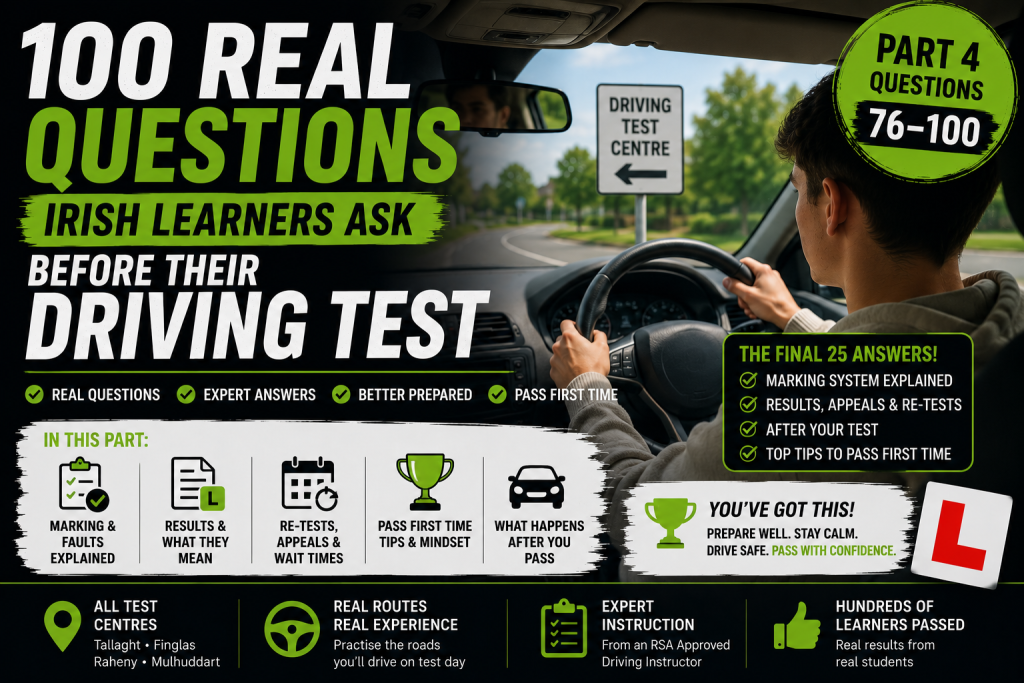
Part 4 – Questions 76–100
Welcome to Part 4
Congratulations—you’ve reached the final part of our complete Irish Driving Test Question Series.
In Parts 1, 2 and 3, we covered everything from theory questions and practical manoeuvres to observation, roundabouts and driving test nerves.
This final section answers the questions learners often ask immediately before and after their test, including:
- Grade 1, Grade 2 and Grade 3 faults
- How results are explained
- Appeals and re-tests
- Passing first time
- What to do if you fail
- The biggest mistakes learners make
Let’s finish with the final 25 questions.
🚗 Your Driving Test Car
76. Do I need L plates on the car?
Yes.
Your car must display correctly fitted L plates on the front and rear of the vehicle if you’re taking the test as a learner.
Damaged, faded or incorrectly positioned plates could result in problems before the test even begins.
Always check they’re clean and securely attached before leaving home.
77. Can I use a dashcam during my driving test?
They normally prefer to have this disconnected before test commences.
The examiner’s priority is that your vehicle is safe and compliant with road traffic regulations.
If you’re unsure about any accessory fitted to your car, discuss it with your instructor before test day.
78. Can I wear sunglasses during the driving test?
Yes.
If the weather is bright, sunglasses can actually improve visibility.
However, make sure they don’t restrict your vision or make it difficult for the examiner to see your observation.
Good observation is still essential.
79. Can I open the window during the test?
Yes.
Many drivers slightly open the window to hear traffic more clearly, particularly at busy junctions or while reversing.
There’s nothing wrong with doing this if it helps you drive safely.
80. Can I adjust my mirrors after moving off?
If it’s safe to do so, yes.
However, it’s much better to adjust your seat and mirrors fully before driving away.
Making repeated adjustments while driving can distract your attention from the road.
📝 Understanding Driving Test Faults
81. What is a Grade 1 fault?
A Grade 1 fault is a minor mistake that has little or no effect on safety.
Examples might include slightly rough clutch control or a small positioning error that doesn’t affect other road users.
Although Grade 1 faults are minor, they still indicate areas where your driving could be improved. ( Grade 1 faults are no longer recorded)
82. What is a Grade 2 fault?
Grade 2 faults are more significant and usually involve repeated mistakes or actions that affect the smooth or safe progress of your drive.
Examples include:
- Missing effective observation
- Poor road positioning
- Hesitation
- Incorrect speed for the conditions
Several Grade 2 faults in the same competency can lead to an unsuccessful result.
👉 Internal Link: How Many Grade 2 Faults Is a Fail?
83. What is a Grade 3 fault?
A Grade 3 fault is a serious error that creates, or has the potential to create, danger.
Examples include:
- Failing to yield when required
- Dangerous observation
- Ignoring a traffic signal
- Causing another road user to take avoiding action
A Grade 3 fault will normally result in an unsuccessful driving test.
84. How many Grade 2 faults can I get?
Any more than 8 Grade 2 faults will result in a test being failed.
The examiner looks at the type, frequency and competency in which the faults occur.
Rather than counting faults, focus on developing consistent, safe driving habits.
85. Are all mistakes marked?
The examiner records faults that relate to the official assessment criteria.
Not every tiny imperfection is recorded, but repeated poor habits or actions affecting safety are likely to be reflected in your result.
Drive naturally rather than worrying about every small movement.
86. Does one serious mistake always mean a fail?
In many cases, a serious fault will result in an unsuccessful test because it indicates that safety has been compromised.
That’s why planning, good observation and sound judgement are so important throughout the drive.
87. Can one small mistake ruin the whole test?
No.
Many learners who pass make several small mistakes.
The key is not letting one error affect the rest of your drive.
Reset mentally and keep concentrating on the next decision.
88. Do they mark every mirror check?
The examiner is assessing your observation throughout the test.
Mirror checks should become a natural part of your driving rather than something exaggerated purely for the test.
Good observation supports safe decisions.
89. Do they mark clutch control?
Yes.
Smooth clutch control is one part of good vehicle control.
Occasional minor mistakes aren’t unusual, but repeated stalling, rolling or poor control may result in faults.
90. Can I pass with faults?
Absolutely.
Very few successful candidates complete a perfect drive.
Passing is about demonstrating safe, competent driving—not perfection.
🏁 After the Driving Test
91. Do I get my result immediately?
Yes.
When you return to the test centre, the examiner will explain your result and discuss any faults recorded during the drive.
Listen carefully and use the feedback to improve, regardless of the outcome.
92. Can I ask why I failed?
Yes.
The examiner will explain the faults that led to the result.
Don’t be afraid to ask polite questions if you need clarification.
Understanding your feedback is the first step towards passing next time.
93. What if I disagree with the result?
It’s natural to feel disappointed, especially if the result wasn’t what you expected.
Take time to review the examiner’s comments with your instructor before deciding on your next steps.
Many learners discover there are valuable lessons hidden within the feedback.
94. Can I appeal my driving test result?
There is a formal process if you believe your test wasn’t conducted correctly.
However, appeals are generally about the administration of the test rather than simply disagreeing with the examiner’s judgement.
Seek advice before deciding whether an appeal is appropriate.
95. How soon can I book another test?
If you’re unsuccessful, you can apply for another test.
Many learners use the waiting period to practise the specific areas highlighted during their assessment.
96. Should I change instructor after failing?
Not necessarily.
Ask yourself:
- Did I receive good preparation?
- Did I understand my weaknesses?
- Have I improved?
Sometimes a fresh perspective helps, but often a focused plan with your current instructor is all that’s needed.
👉 Internal Link: Driving Test Recovery Evaluation
97. Should I book another mock test?
Yes.
A mock test is one of the best ways to measure your progress before returning for another practical test.
It helps identify whether previous faults have been corrected and highlights anything that still needs work.
98. What should I practise before rebooking?
Focus on the faults listed by the examiner.
Avoid simply driving around without a plan.
Targeted practice produces much better results than repeating the same habits.
99. How many people pass first time?
Pass rates vary between test centres and over time.
Rather than worrying about statistics, concentrate on your own preparation.
The learners who consistently pass are those who practise regularly, complete mock tests and understand the Rules of the Road.
100. What’s the biggest mistake learners make?
The biggest mistake isn’t stalling.
It isn’t touching a kerb.
It isn’t forgetting one mirror check.
The biggest mistake is allowing one small error to destroy the rest of the drive.
Every road is a new opportunity.
Reset your mind, focus on the next decision and keep driving safely.
Many successful learners leave the test convinced they’ve failed—only to hear the examiner say, “Congratulations, you’ve passed.”
Final Thoughts
If you’ve read all four parts of this guide, you’ve now worked through 100 of the most common questions Irish learner drivers ask before their driving test.
Our goal wasn’t simply to answer questions—it was to help you understand how the driving test works, reduce unnecessary anxiety and give you the confidence to perform at your best on test day.
Remember:
✅ Preparation beats luck.
✅ Safe habits beat perfect driving.
✅ Confidence comes from practice.
Whether you’re preparing for your first attempt or returning after a previous test, every lesson and every mock test brings you one step closer to becoming a safe, confident driver.
We wish you the very best of luck with your Irish driving test—and we hope to be congratulating you on your pass very soon.
Continue Exploring
From this page, link naturally to:
- Part 1 – Questions 1–25
- Part 2 – Questions 26–50
- Part 3 – Questions 51–75
- Driving Test Preparation Guide
- Mock Driving Test Dublin
- Driving Test Recovery Evaluation
- How Many Grade 2 Faults Is a Fail?
- Will I Fail If I Stall?
- Yellow Box Junction Rules
- Roundabout Guide
- Observation at Junctions
- Warm-Up Lesson Before Your Test