Welcome to Part 2
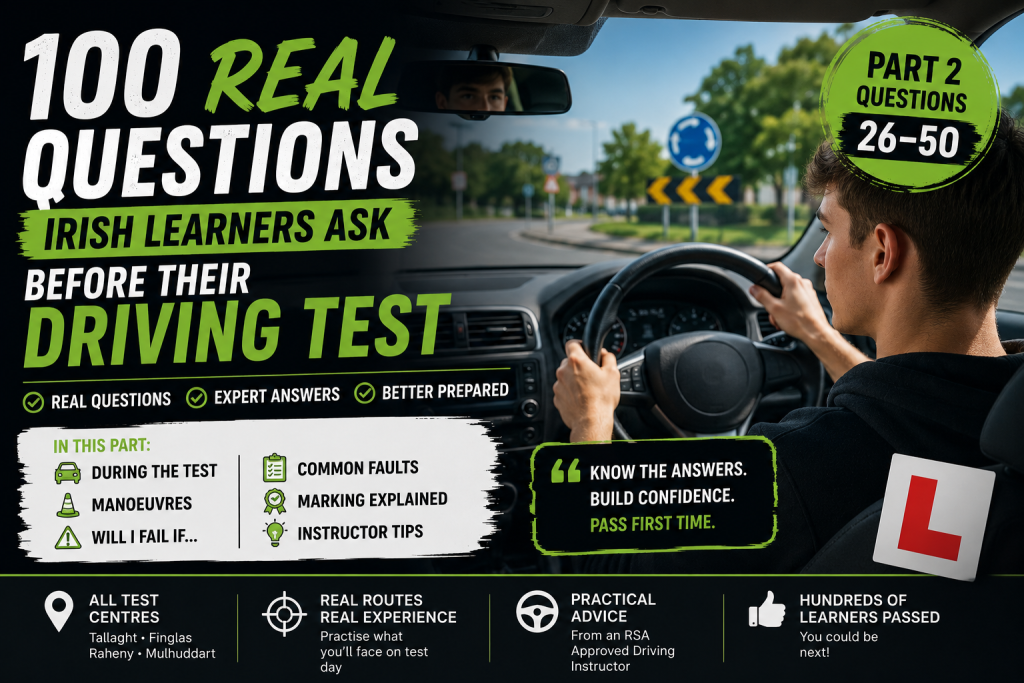
Welcome back to our complete guide to the Irish driving test.
If you’ve already read Part 1, you’ll now understand what happens before the test starts, what documents you’ll need and the theory questions you may be asked.
In this section we’re looking at what happens during the practical driving test and answering some of the biggest questions learners ask before getting behind the wheel.
Many of these are panic searches such as:
“Will I fail if I hit the kerb?”
“Do I always have to reverse around a corner?”
The good news is that many of these fears are based on myths. Let’s clear them up.
📋 Theory Questions Continued
26. Can I fail because of the theory questions?
The questions asked before you begin driving form part of your overall assessment, so it’s important to prepare for them. The examiner wants to know that you understand the Rules of the Road and can safely operate your vehicle.
Questions may cover road signs, road markings, vehicle controls, hand signals and basic safety checks.
The easiest way to prepare is to revise little and often in the weeks before your test rather than trying to memorise everything the night before. If you don’t know an answer, don’t panic. Stay calm, think about the question and answer as clearly as you can.
👉 See guide: Driving Test Preparation Guide
27. What are the most common theory questions?
Although every test is different, certain topics appear regularly.
You should expect questions about:
- Road signs
- Road markings
- Speed limits
- Right of way
- Hand signals
- Warning lights
- Vehicle controls
- Tyres
- Lights
- Under-the-bonnet checks
Many instructors include these questions during mock tests so nothing comes as a surprise on test day.
Remember, understanding the reasons behind each answer is far better than simply memorising responses.
28. Will they ask about yellow box junctions?
They certainly can.
Yellow box junctions are a common source of confusion for learner drivers, so it’s important to understand when you can and cannot enter one.
A common mistake is driving into the yellow box before your exit is clear, leaving your vehicle blocking the junction when traffic stops.
The examiner wants to see good planning and anticipation rather than rushing.
If you aren’t sure whether you’ll clear the junction, it’s usually safer to wait.
👉 Guide here: Yellow Box Junction Rules Explained
29. Do they ask motorway questions?
Although motorway driving isn’t part of the practical driving test itself, you may still be asked questions relating to motorway rules.
For example:
- Minimum speeds
- Overtaking
- Lane discipline
- Hard shoulder use
- Motorway signs
Knowing these rules shows that you understand safe driving beyond everyday town driving.
30. How should I revise before my driving test?
Avoid trying to learn everything in one evening.
Instead:
✔ Read the Rules of the Road
✔ Revise road signs
✔ Learn the vehicle controls
✔ Complete a mock driving test
✔ Review your instructor’s feedback
Good preparation builds confidence, and confident drivers usually make better decisions.
🚘 During The Practical Driving Test
31. How long is the Irish driving test?
The practical driving test usually lasts around 50 minutes, although this can vary slightly depending on traffic conditions.
The assessment includes:
- Theory questions
- Vehicle safety questions
- Practical drive
- Manoeuvre(s)
- Result
Many learners say the time passes much quicker than they expected because they’re concentrating on driving.
32. Do they always ask you to reverse around a corner?
Yes always.
The examiner will ask you to complete one or more manoeuvres during the test, but the exact manoeuvre can vary.
This is why it’s important to practise all of them rather than hoping for a particular exercise.
Your instructor should prepare you for every possibility so nothing feels unfamiliar on the day.
33. Will I have to do a turnabout?
Yes
The turnabout remains one of the manoeuvres you should be prepared for.
The examiner isn’t looking for perfection—they’re looking for:
✔ Observation
✔ Good control
✔ Safe positioning
✔ Awareness of other road users
Take your time.
Rushing usually creates more faults than driving slowly and safely.
34. Will I have to park?
You may be asked to complete a parking exercise depending on the route and circumstances, generally parking on the left in housing estates, parking back in test centre
Whatever manoeuvre you’re asked to perform, the examiner wants to see good observation, vehicle control and awareness of pedestrians, cyclists and other traffic.
Practise parking in different locations rather than relying on one familiar space.
35. Does everyone drive the same route?
No.
Each test centre has several different routes available.
The examiner may choose any suitable route depending on traffic, roadworks or weather.
This prevents learners simply memorising one route without developing safe driving skills.
Instead of memorising roads, focus on developing good habits that work everywhere.
36. Can the examiner change the route?
Yes.
If traffic conditions change, there is an accident or roadworks appear, the examiner may simply choose another road.
This isn’t a trick.
It’s just part of driving safely in real traffic.
Continue driving normally and follow any new instructions given.
37. Will I drive on roundabouts?
In most areas, yes.
Roundabouts allow the examiner to assess:
- Lane discipline
- Observation
- Signalling
- Positioning
- Judgement
- Planning
These are some of the most important skills you’ll use every day after passing your test.
38. Will I drive on dual carriageways?
Many driving tests include roads with higher speed limits or dual carriageways where appropriate.
The examiner wants to see that you can:
✔ Build speed safely
✔ Maintain lane discipline
✔ Check mirrors correctly
✔ Join traffic confidently
Don’t be afraid of higher speed roads—smooth, confident driving is exactly what the examiner wants to see.
39. What if there’s heavy traffic?
Heavy traffic is completely normal.
The examiner understands that traffic affects everyone’s journey.
They aren’t expecting you to make impossible progress.
Instead, they’ll assess how safely you deal with changing traffic conditions.
Stay patient.
Maintain good observation.
Keep a safe distance.
Never allow pressure from drivers behind you to rush your decisions.
40. What if roadworks change the route?
Simply continue driving safely.
Roadworks happen every day.
The examiner will adapt the route if necessary.
Don’t panic because the route looks unfamiliar.
Safe driving is always more important than following a planned route.
❌ Will I Fail If…
41. Will I fail if I stall?
Not necessarily.
One of the biggest myths surrounding the Irish driving test is that a single stall means automatic failure.
In reality, it depends entirely on what happens afterwards.
If you stall, stay calm.
Secure the car.
Restart the engine safely.
Check your mirrors and blind spot before moving off again.
Many learners who pass admit they stalled once during their test.
It’s your reaction that matters.
👉 Stalling guide: Will I Fail If I Stall?
42. Will I fail if I hit the kerb?
Lightly brushing the kerb isn’t always an automatic fail.
However, mounting the kerb heavily or striking it with significant force may indicate poor vehicle control.
The examiner considers:
- Severity
- Safety
- Risk created
- Overall control
Good positioning and observation reduce the chances of this happening.
👉 More info: Hitting The Kerb During Your Driving Test
43. Will I fail if I mount the footpath?
Mounting the footpath is much more serious than lightly touching a kerb.
Driving onto the pavement can place pedestrians at risk and usually results in a serious fault.
Take your time during manoeuvres.
Remember:
Slow is smooth.
Smooth is safe.
44. Will I fail if I forget a mirror check?
Mirror checks are one of the most closely observed parts of the driving test.
Missing one quick mirror glance isn’t necessarily an automatic fail.
However, repeatedly moving off, changing lanes or turning without effective observation can quickly lead to multiple faults.
Make your observation natural—not exaggerated—but always complete.
45. Will I fail for hesitation?
It depends.
Good judgement sometimes means waiting.
Excessive hesitation, however, can affect traffic flow and may result in faults if safe opportunities to proceed are repeatedly missed.
Ask yourself:
Is it safe?
If yes, go.
If not, wait.
The examiner wants balanced decision-making.
👉 More info: Hesitation on the driving test
46. Will I fail for driving too slowly?
Driving significantly below the speed limit without good reason can result in faults.
Driving too slowly may:
- Hold up traffic
- Suggest a lack of confidence
- Create unnecessary hazards
Aim for steady, appropriate progress while always adjusting for weather, visibility and traffic.
👉 More info: Driving too slow guide
47. Will I fail if I speed once?
Momentarily drifting a little above the speed limit isn’t viewed the same as deliberately speeding.
However, failing to recognise speed limits or continuing above them can result in serious faults.
Constant speed awareness is an important part of safe driving.
Scan ahead.
Read the road signs.
Check your speed regularly.
48. Will I fail if I forget to indicate?
Indicators communicate your intentions to other road users.
Forgetting one signal won’t automatically mean failure.
The examiner will consider:
Was anyone affected?
Did another road user need that information?
Was the manoeuvre still safe?
Good observation remains more important than signalling when no one is there to benefit.
49. Will I fail if I stop in a yellow box?
Stopping in a yellow box because your exit wasn’t clear can result in faults.
Good planning is the key.
Before entering any yellow box ask yourself:
“Can I clear it completely?”
If the answer is no…
Wait.
That simple habit prevents one of the most common driving test mistakes.
👉 More info: Yellow Box Junction Guide
50. Will I fail if I take the wrong lane?
Taking the wrong lane doesn’t automatically mean you’ve failed.
What matters is how you deal with it.
If you’ve chosen the wrong lane:
✔ Stay calm
✔ Continue safely
✔ Follow the road
✔ Don’t make sudden lane changes
A safe mistake is usually much better than an unsafe correction.
Final Thoughts
If you’ve reached this point, you’ve now answered 50 of the most common questions Irish learner drivers ask before their driving test.
Hopefully, you’re beginning to realise something important:
Most people don’t fail because of one mistake. They fail because of repeated poor habits.
Build good habits, stay calm, and trust your preparation.
Continue Your Journey
👉 Read Part 3 – Questions 51–75
Next, we’ll answer questions about:
- Roundabouts
- Right of way
- Junctions
- Observation
- Nerves
- Coffee before your test
- Talking to the examiner
- Driving in the rain
- Sunglasses
- Preparing your car