Welcome to Part 3
By now you’ve completed the first two parts of our Irish Driving Test Question Series.
You’ve learned what happens before the test, what the examiner is looking for and how faults are assessed.
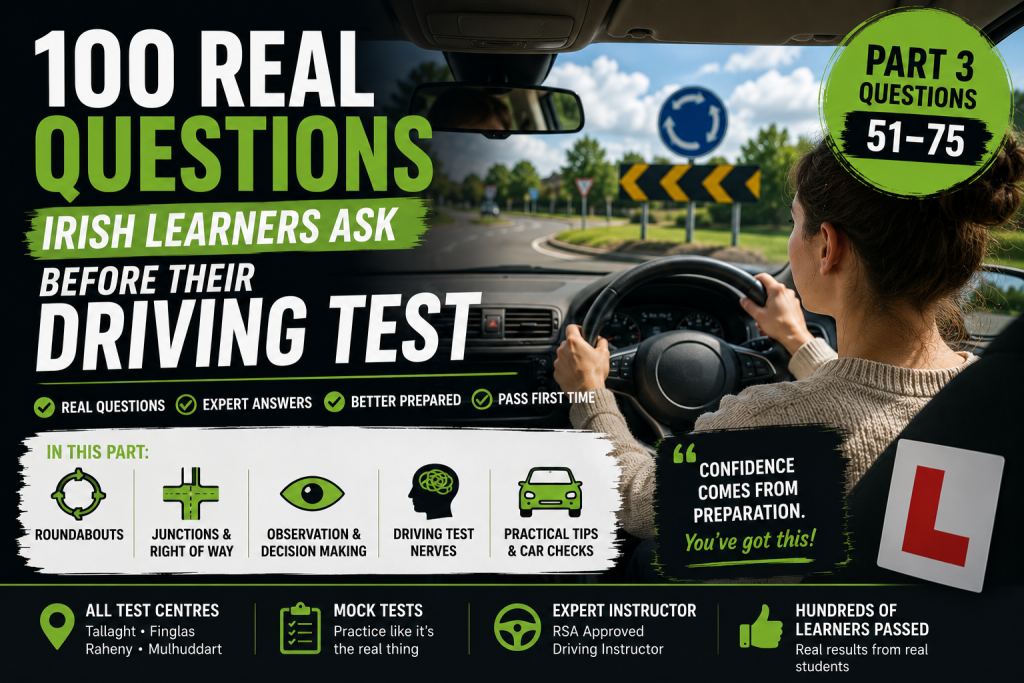
In this section we’re moving on to the areas that cause more Grade 2 faults than almost anything else:
- Observation
- Junctions
- Roundabouts
- Right of way
- Decision making
- Driving test nerves
These are the situations where many otherwise good drivers lose marks, not because they can’t control the car, but because they’re unsure about when to go, where to look or how to react under pressure.
Let’s answer the next 25 questions.
🚦 Junctions & Roundabouts
51. How much observation is enough?
Observation isn’t about making exaggerated head movements—it’s about gathering the information you need before acting.
Before moving off, turning, changing lanes or reversing, you should check mirrors, blind spots where appropriate and look in the direction you intend to travel. The examiner wants to see that you’ve assessed what’s around you and made a safe decision.
A common mistake is checking mirrors too late or looking without actually taking in what you see. Good observation should always lead to good judgement.
👉 More info: Observation at Junctions
52. What if another driver flashes me to go?
Treat a flash as information, not permission.
The other driver may be giving way, but it’s still your responsibility to make sure it’s safe before moving. Check for cyclists, pedestrians and traffic from other directions before proceeding.
Never rely solely on another driver’s signal.
53. Who has priority at a junction?
Priority depends on the road layout, road signs and markings.
If you’re approaching a Stop or Yield sign, you must give way to traffic on the major road. At unmarked junctions, you should slow down, assess the situation and proceed only when it’s safe.
When in doubt, don’t guess—wait until you’re certain.
54. How long should I wait at a junction?
Wait as long as necessary to make a safe decision—but no longer.
One of the most common faults is unnecessary hesitation. If there’s a safe gap and you repeatedly fail to take it, you may lose marks for progress.
Balance is the key: don’t rush into danger, but don’t let good opportunities pass either.
55. What if someone beeps at me?
Ignore the horn and focus on driving safely.
Other road users may be impatient, but they’re not assessing your driving—the examiner is. If you’re waiting because it’s unsafe to move, continue waiting until it’s safe.
Never let another driver’s impatience pressure you into making a poor decision.
56. Can I wave another driver through?
Beckoning can lead to instant failure
Instead of waving someone through, allow the normal rules of the road to work. Misunderstandings can occur if people interpret your gesture differently.
Drive predictably rather than trying to manage everyone else’s decisions.
57. How should I approach mini-roundabouts?
Approach slowly, observe early and choose the correct position.
Many learners focus only on vehicles already on the roundabout and forget to check for traffic approaching from the right. Good lane discipline and clear signalling will help you deal with mini-roundabouts confidently.
👉 More info: Mini Roundabout Guide
58. Should I indicate when going straight at a roundabout?
This depends on the type of roundabout and the exit you’re taking.
In general, you should signal left as you pass the exit before the one you intend to take. Clear signalling helps other road users understand your intentions.
Always follow the Rules of the Road and your instructor’s guidance.
👉 More info: Roundabout Signalling Guide
59. How close should I stop behind another vehicle?
Leave enough space to see the rear tyres of the vehicle in front touching the road.
This gives you room to move away safely if necessary and reduces the risk of rolling into the vehicle ahead.
Maintaining a safe stopping distance is especially important in heavy traffic.
60. Can I cross a solid white line?
Only in the limited situations permitted by the Rules of the Road, such as passing a stationary obstruction when it is safe and legal to do so.
Crossing a solid white line without a valid reason may result in a fault or more serious consequences depending on the circumstances.
😬 Driving Test Nerves
61. Is it normal to be nervous?
Absolutely.
Almost every learner feels nervous before their driving test. Even experienced drivers often feel pressure during assessments.
The goal isn’t to eliminate nerves—it’s to stop them affecting your driving. Good preparation, mock tests and familiar routes all help reduce anxiety.
62. What if my leg shakes on the clutch?
This is surprisingly common.
Take a slow breath before moving off and avoid rushing. Once you begin driving, most learners find the shaking settles within a few minutes as they focus on the road.
Remember, the examiner has seen nervous candidates many times before.
63. Can I tell the examiner I’m nervous?
Yes.
Many learners mention that they’re feeling nervous, and there’s nothing wrong with doing so. It doesn’t change the marking, but it can help you feel more relaxed.
The examiner understands that driving tests are stressful.
64. Can I take a few deep breaths before moving off?
Yes.
The examiner will usually ask you to move off when you’re ready. Use those few moments to compose yourself, adjust your mirrors if necessary and begin when you feel prepared.
Several of your own successful students have shared this as one of their best test-day tips.
65. Can I ask for a moment before driving away?
Yes, provided you’re not causing an unnecessary delay.
If you need a few seconds to settle yourself before moving off, that’s perfectly reasonable. The important thing is to remain calm and start the drive safely.
66. What if I panic after making a mistake?
Don’t assume you’ve failed.
Many candidates make a small mistake early in the test and then spend the rest of the drive thinking about it. That often leads to more faults.
Instead, treat each new road as a fresh start. Focus on the next decision, not the last one.
67. Should I drink coffee before my driving test?
It depends on how your body reacts.
If you normally drink coffee and it helps you feel alert, that’s fine. If caffeine tends to make you jittery or anxious, it may be better to avoid it before your test.
Don’t make major changes to your routine on test day.
68. Should I eat before my driving test?
Yes.
A light meal or snack can help you stay focused and avoid feeling light-headed during the test.
Avoid arriving hungry or eating a very heavy meal immediately beforehand.
69. Does everyone feel nervous?
Almost everyone.
Even learners who look confident often admit afterwards that they were extremely nervous.
The difference is that well-prepared learners don’t let nerves control their decisions.
70. What’s the best way to stay calm?
Preparation is the biggest confidence booster.
Complete a mock test, revise the Rules of the Road, know your vehicle and get a good night’s sleep.
On the day, remember that the examiner isn’t looking for perfection—they’re looking for safe driving.
🚗 Your Driving Test Car
71. What should I check before leaving home?
Walk around your car and check:
- Tyres
- Lights
- Indicators
- Mirrors
- Number plates
- L plates
- Fuel level
- Washer fluid
A two-minute inspection can prevent unnecessary stress later.
72. How much fuel should I have?
You don’t need a full tank, but make sure you have plenty of fuel for the test and any warm-up lesson beforehand.
Running low on fuel during a driving test is easily avoided with a little planning.
73. Can I use an automatic car?
Yes, provided your learner permit and booking are for an automatic vehicle.
Remember that passing your test in an automatic restricts you to driving automatic cars unless you later pass a manual test.
74. Can I use my instructor’s car?
Yes, and many learners choose to do exactly that.
Your instructor’s vehicle is already familiar, properly maintained and usually meets all test requirements.
Using a car you know well often improves confidence.
75. What if it starts raining during my driving test?
Carry on driving as you normally would.
Adjust your speed if necessary, increase your following distance and use your wipers and lights appropriately.
Rain is part of everyday driving, and the examiner simply wants to see that you adapt safely to the conditions.
Final Thoughts
You’ve now completed 75 of the 100 most common questions Irish learners ask before their driving test.
If you’ve worked through Parts 1, 2 and 3, you’ll have a much clearer understanding of what to expect and how to prepare.
Continue Reading
👉 Part 4 – Questions 76–100
In the final section we’ll cover:
- Sunglasses and windows
- Dashcams
- Grade 1, Grade 2 and Grade 3 faults
- Appeals
- Rebooking after a fail
- Getting your result
- Passing first time
- The biggest mistakes learners make