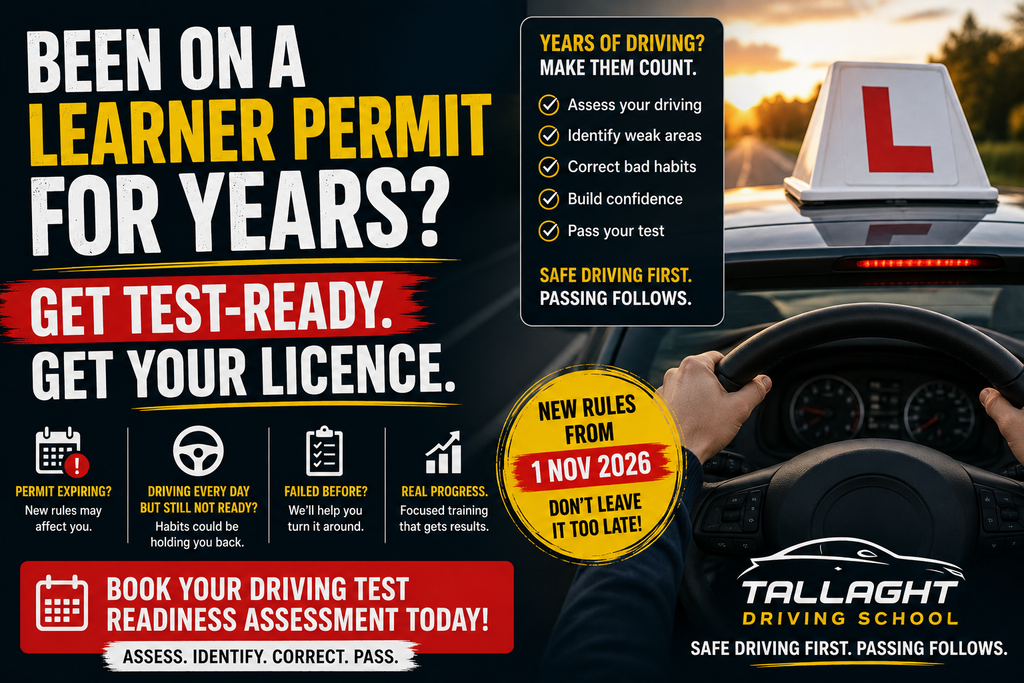
Been on a Learner Permit for Years? How to Get Driving-Test Ready
You’ve been driving for years. That doesn’t mean you need to start again.
If you’ve held a learner permit for several years, you may already have plenty of real-world driving experience.
You may drive regularly.
You may know the roads.
You may be confident in traffic.
You may even feel completely comfortable behind the wheel.
But there is one question that matters now:
Are you driving at test standard?
With new learner permit rules increasing the pressure on long-term learners to progress towards the full licence, this is a good time to find out.
At Tallaght Driving School, we don’t automatically treat experienced learners like beginners.
We start by assessing the driving you already have.
Then we identify the gap between:
🚗 Everyday driving
and
🏁 Driving-test-ready driving.
🎯 Been Driving for 3, 4, 5 or More Years?
Start With an Assessment — Not a Block of Lessons
If someone has been driving for years, it makes very little sense to automatically put them back through beginner-style training.
You already have experience.
The question is what that experience has produced.
Some long-term learners are already very close to test standard.
Others have developed habits over the years that could cause repeated faults during the test.
Our first job is to establish which one you are.
✅ Driving Test Readiness Assessment
We assess.
We identify.
We build a plan.
[BOOK YOUR DRIVING TEST READINESS ASSESSMENT]
🧠 Why Experienced Learners Can Still Struggle With the Driving Test
Driving every day gives you valuable experience.
But everyday driving and test driving aren’t always identical.
Over time, routines become automatic.
You stop thinking about every mirror check.
You develop your own way of approaching junctions.
You become comfortable with familiar roundabouts.
You may rely on experience rather than deliberately planning each situation.
Most of the time, that feels perfectly normal.
But the driving test is assessing whether your driving is:
✅ safe
✅ consistent
✅ planned
✅ observant
✅ controlled
✅ independent
The examiner isn’t interested in how many years you’ve driven.
They’re interested in what you demonstrate during the test.
🔎 Common Habits Long-Term Learners Develop
👀 Observation
One of the biggest areas.
You may be looking at the right things without making your observation systematic enough.
Common issues include:
- missing observations at junctions
- weak observation during manoeuvres
- not scanning far enough ahead
- focusing too much on one hazard
- failing to re-check when circumstances change
🪞 Mirrors
Experienced drivers often use mirrors instinctively.
That’s good.
But some develop gaps around:
- changing speed
- changing direction
- moving around parked vehicles
- changing lanes
- responding to hazards
The problem is rarely knowing what a mirror is for.
It’s consistency.
⭕ Roundabouts
Years of driving can create strong habits.
Sometimes those habits are good.
Sometimes they include:
- selecting a lane too late
- drifting across lanes
- poor observation
- signalling too early or too late
- reacting rather than planning
Roundabouts expose a lot about a driver’s planning.
🚦 Junctions
Junctions combine:
👀 observation
⚖️ speed
📍 position
🧠 judgement
🚗 control
A driver can feel confident at junctions while still approaching too quickly, emerging with limited observation or making rushed decisions.
↔️ Positioning
Positioning faults often feel small.
But repeated throughout a test they can become significant.
Examples include:
- driving too close to parked cars
- sitting too far from the kerb
- cutting corners
- poor lane discipline
- positioning late for turns
📈 Progress
Some experienced learners become overly cautious when being assessed.
Suddenly they drive very differently from normal.
They may:
- hesitate unnecessarily
- wait for excessively large gaps
- drive too slowly
- hold up traffic
- lose confidence at busy junctions
Safe doesn’t mean excessively slow.
The objective is safe, appropriate progress.
⚠️ Hazard Response
Long-term experience should help with hazard awareness.
But it can also create automatic reactions.
Some drivers react too late.
Others react too strongly.
Our principle is:
React. Don’t overreact.
A developing hazard requires an appropriate response.
Not panic.
🧭 Planning
One of the biggest differences between confident driving and consistently good driving is planning.
Our approach is:
PLAN — DON’T REACT.
Look further ahead.
Identify what’s developing.
Decide early.
Adjust early.
Then drive through the situation calmly.
The less you leave to the last second, the easier driving becomes.
🚗 “But I Drive Every Day”
Good.
That experience can be a major advantage.
We’re not trying to remove it.
We’re trying to use it.
A long-term learner may already have:
✅ strong clutch control
✅ good steering
✅ confidence
✅ road awareness
✅ experience in traffic
✅ familiarity with different conditions
These are assets.
The objective isn’t to turn you back into a beginner.
The objective is to remove the habits that could prevent you demonstrating your real ability during the test.
🔍 What Happens During a Driving Test Readiness Assessment?
We begin by looking at your current standard.
We may assess:
👀 Observation
Are you seeing situations early enough?
🪞 Mirrors
Are mirror checks appropriate and consistent?
🚦 Junctions
Are your speed, position and observations correct?
⭕ Roundabouts
Are you planning lanes and exits early?
↔️ Positioning
Are you consistently positioned correctly?
📈 Progress
Are you driving at an appropriate pace?
⚖️ Speed
Are you managing speed according to the road and conditions?
🚶 Pedestrians
Are you anticipating what pedestrians may do?
⚠️ Hazards
Are you responding proportionately?
🅿️ Manoeuvres
Are your manoeuvres controlled with effective observation?
🧠 Independence
Can you make safe decisions without constant prompting?
📊 Then We Tell You Where You Stand
There are usually three broad outcomes.
🟢 Nearly Test-Ready
This is common with experienced learners.
You may need:
- minor corrections
- manoeuvre practice
- test-specific preparation
- a realistic mock test
- confidence under assessment conditions
That may not require many lessons.
🟠 Good Driver — But Several Test Habits Need Work
You may already drive comfortably but have repeated problems such as:
- mirrors
- observation
- positioning
- hesitation
- lane discipline
- progress
These are usually very workable.
The important thing is identifying the pattern.
🔴 Significant Safety or Consistency Issues
Sometimes years of experience can hide weaknesses.
If we see issues that need more work, we’ll tell you.
We would rather give you an accurate assessment than tell you what you want to hear and send you into a test unprepared.
The goal is not simply to sit the test.
The goal is to become capable of passing because your driving is consistently safe.
🏁 Safe Driving First. Passing Follows.
This is our approach throughout test preparation.
We are not teaching tricks to fool an examiner.
We’re building better driving.
The driving test is simply an opportunity to demonstrate it.
When your:
👀 observation
🪞 mirrors
🚦 judgement
📍 positioning
⚖️ speed
🧠 planning
and
🚗 control
are consistently right, the result becomes much more likely to follow.
Safe driving first. Passing follows.
🔄 Failed Before?
That doesn’t mean you need to start again either.
Previous tests can actually be useful.
If you still have your test report, bring it.
We’ll compare the faults from your previous test with the way you’re driving today.
Maybe the same issues are still there.
Maybe you’ve already corrected them.
Maybe a completely different problem is now more important.
Either way, we use information rather than guessing.
[READ OUR DRIVING TEST RECOVERY GUIDE]
😬 Nervous About Going Back for the Test?
This is very common.
The longer someone delays a driving test, the bigger it can become in their head.
You may start thinking:
“I’ve been driving for years. What if I fail?”
That’s understandable.
But putting the test off doesn’t necessarily make the driving better.
Preparation does.
The best way to reduce uncertainty is to establish where your driving stands.
Once you know what needs work, the problem becomes much smaller.
🪪 New Learner Permit Rules Make Planning More Important
From 1 November 2026, Ireland’s rules around multiple learner permits become stricter.
For drivers progressing to a third or fourth learner permit, simply booking a driving test is no longer enough.
You may need to have actually undertaken a driving test within the required timeframe.
Fourth permits are also limited to one year, and continuing indefinitely through learner permits is no longer the same option it once was.
If you’ve been putting the driving test off for years, the message is simple:
Don’t leave it until your permit forces the issue.
Start preparing while you still have options and time.
📚 New Learner Permit Rules – Read the Full Guides
🚗 New Learner Permit Rules Ireland 2026
Understand the overall changes starting from 1 November 2026.
[READ THE FULL LEARNER PERMIT RULES GUIDE]
3️⃣ Third Learner Permit Ireland 2026
Currently on your second learner permit?
[READ THE THIRD PERMIT GUIDE]
4️⃣ Fourth Learner Permit Ireland 2026
Already approaching your fourth permit?
[READ THE FOURTH PERMIT GUIDE]
⏳ Learner Permit Expiring in 2026
Check what to do before your permit expires.
[READ THE PERMIT EXPIRY GUIDE]
📍 Preparing for the Tallaght Driving Test?
Tallaght Driving School specialises in preparing learners for test-standard driving.
Our focus isn’t simply memorising test routes.
Routes change.
Traffic changes.
Examiners may choose different areas.
You need skills that work wherever the test goes.
That means:
🧠 planning
👀 scanning
⚠️ hazard awareness
⭕ roundabout judgement
🚦 junction control
↔️ positioning
📈 appropriate progress
Good preparation should make you adaptable.
Not dependent on knowing the next turn.
🎯 Stop Guessing Whether You’re Ready
You may be better than you think.
Or you may have several habits that need work.
Either outcome is useful.
Because once we know where you stand, we can create a realistic plan.
Driving Test Readiness Assessment
Ideal if you:
✅ have been on learner permits for years
✅ drive regularly
✅ haven’t had professional lessons recently
✅ failed a test previously
✅ aren’t sure what test standard looks like now
✅ have a learner permit approaching expiry
✅ want an honest assessment before booking lots of lessons
✅ want to finally move towards the full licence
🚗 You’ve Already Done the Hard Part
You’ve learned to control the car.
You’ve gained road experience.
You’ve dealt with traffic.
You’ve driven in real situations.
Now we refine it.
🔍 Assess.
🎯 Identify.
🛠️ Correct.
🧪 Test.
🏁 Finish.
[BOOK YOUR DRIVING TEST READINESS ASSESSMENT]
Tallaght Driving School
Safe driving first. Passing follows.
Frequently Asked Questions
I’ve been on a learner permit for years. Do I need to start driving lessons again?
Not necessarily.
If you already have significant driving experience, the best first step is usually an assessment.
That allows us to establish what you actually need rather than assuming you’re a beginner.
How many lessons will I need before my driving test?
There is no honest way to answer that without seeing you drive.
Some experienced learners need very little work.
Others have several habits that need correcting.
We assess first.
Can someone be a good driver but still fail the driving test?
Yes.
A driver may be experienced but have recurring problems with observation, mirrors, positioning, progress or other test areas.
Consistency matters.
I’ve been driving for five or six years. Is that an advantage?
It can be.
Road experience, confidence and vehicle control are useful.
But experience can also create habits.
We want to keep the experience and remove the weaknesses.
Is the assessment suitable if I’ve failed before?
Yes.
Bring your previous test report if possible.
That gives us additional information to work with.
Should I learn driving test routes?
Knowing an area can help you feel comfortable, but route memorisation should not be the basis of your preparation.
Routes and conditions change.
You need driving skills that work wherever you’re taken.
I’m nervous because I’ve delayed the test for years. Is that normal?
Yes.
Long delays can make the test feel bigger than it is.
A realistic assessment and clear preparation plan usually make the situation much easier to manage.
Do the new learner permit rules affect long-term learners?
They can.
From 1 November 2026, stricter rules apply to multiple learner permits, particularly drivers progressing to third and fourth permits.
Read our full learner permit rules guide for details and confirm your own permit eligibility with the RSA or NDLS.
🔗 Official Learner Permit Information
Learner permit eligibility and renewal requirements are determined by the relevant authorities.
For official information, always check the:
Road Safety Authority
and
National Driver Licence Service
Tallaght Driving School provides driver training and driving-test preparation.
We do not determine learner permit eligibility.
Been Driving for Years?
Good.
We’re not starting from zero.
We’re starting from where you are today.
Then we’ll find out what separates your current driving from the full licence.
[BOOK YOUR DRIVING TEST READINESS ASSESSMENT]
Tallaght Driving School